
Edge AI: Power, Co-Design and the Future of On-Device Intelligence
Power and thermal efficiency have become primary design constraints for edge AI, not optional optimizations. Unlike cloud-based training and inference, where infrastructure can scale almost indefinitely, edge systems require hardware architectures built from the ground up for tight energy budgets, small form factors, and low costs. Successful edge AI deployment depends on deep hardware-software-model co-design—power is not just important; it is a first-class design citizen.
While most industry attention focuses on large-scale AI training in data centers, edge inference is where trained models deliver real-world value. In the cloud, power is critical due to massive consumption, driving advances in cooling and packaging. On the edge, however, every milliwatt matters, especially for battery-powered devices. Engineers must navigate complex tradeoffs between performance, power, size, and cost. Though edge AI has received less publicity, it will drive significant long-term revenue and sustainability for the entire AI industry.
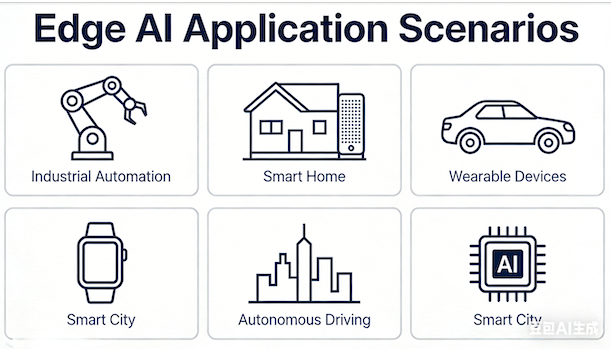
Edge AI adoption is accelerating across sectors: industrial automation (predictive maintenance, anomaly detection), building and home automation (smart thermostats, video doorbells), wearables, and smart cities (traffic and pedestrian management). Performance requirements vary drastically by device. High-end applications like smartphones and automobiles demand highly optimized, application-specific AI designs, while mass-market consumer goods such as smart appliances rely on more generic, cost-efficient solutions.

In the cloud, resources are scalable—more memory, hardware, and cooling can be added as needed. Edge devices face hard physical limits, particularly battery-powered systems with strict power budgets. Running sophisticated AI models under these constraints is extremely challenging. Tight energy and thermal envelopes require high-efficiency power delivery, high power density in compact layouts, and cost-effective designs for high-volume deployment. Excessive heat becomes a critical issue, as most edge systems are fanless and cannot support large heat sinks.
Energy efficiency affects far more than just battery life—it directly drives thermal behavior and hotspot management, especially under bursty workloads from sensors and radios. Simply porting cloud or training models to edge inference is not viable. Training uses large batches, parallel GPUs, and backward/forward propagation with high latency tolerance. Edge inference typically uses a batch size of one, so architectures must efficiently utilize hardware through network structure optimization rather than data parallelism.
Effective edge AI design requires holistic optimization of compute, memory hierarchies, and on-chip interconnects—not just shrinking data-center chips. Data movement between the processor and external memory often consumes more power than the computation itself. As a result, on-chip SRAM, weight compression, and model optimization are widely used to minimize off-chip access. Coarse-grained power gating and burst-aware interconnects further improve efficiency without excessive overhead.
For high-performance edge applications such as autonomous vehicles and robots, chiplet-based architectures are emerging to deliver peta-ops level computing within practical power and area budgets. Meanwhile, cost-sensitive commodity devices increasingly adopt modular chiplet designs to improve yield and lower bill-of-materials costs.
Hardware-software-model co-design is no longer optional. Teams must align on supported operations, numerical precision, memory usage, and power budgets from the earliest architectural stages. Tools and compilers must provide end-to-end visibility into neural network execution to enable global optimizations, including quantization, knowledge distillation, and activation management.
Future-proofing remains a major challenge given the rapid evolution of AI models. Edge devices often have long lifecycles, so systems must support firmware updates, configurable power rails, and scalable power delivery without full redesigns. The goal is to preserve flexibility within fixed power and thermal limits, not over-engineer for unknown future workloads.
In summary, edge AI is no longer a secondary extension of cloud computing. It demands a complete rethink of design methodology, with power and co-design at its center. Long-term success will go to teams that build dedicated edge architectures, tools, and workflows—rather than incrementally adapting existing solutions.